

Ready-to-Fly Drones · Shop by specification
Find the right ready-to-fly drones faster.
Choose the aircraft type and package format that matches how quickly you want to get flying.


15-30 Days
Free

Our courier will deliver to the specified address
7-15 Days
From $20

courier will deliver to the specified address
3-5 Days
From $40
$25.99
Out of stock
Out of stock
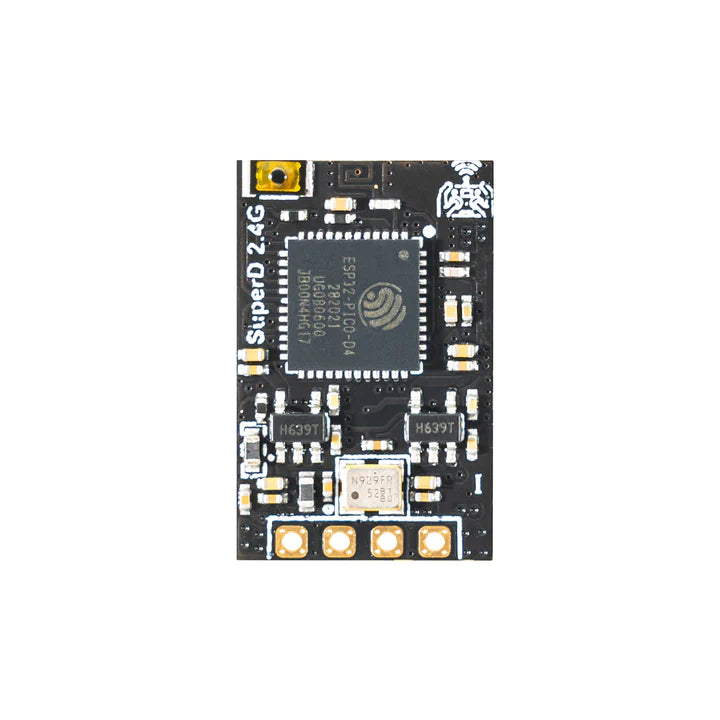
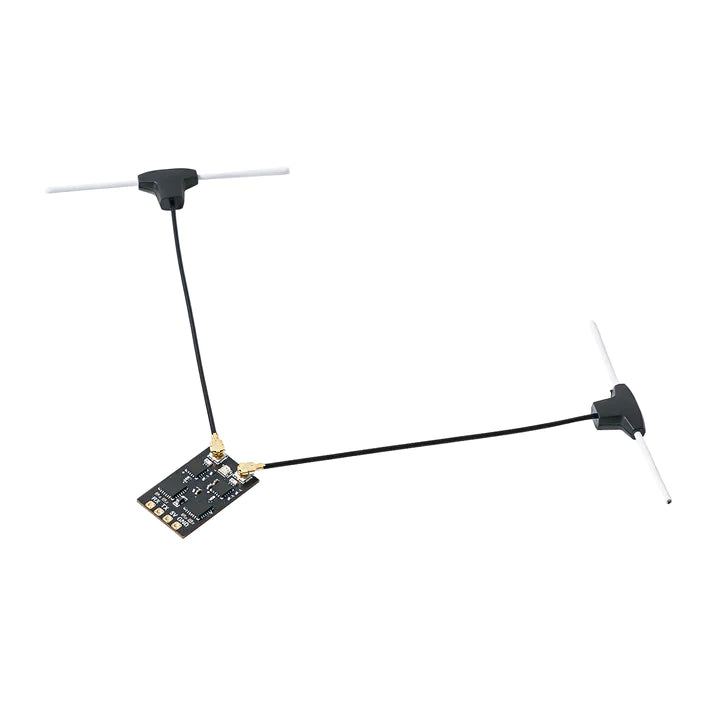
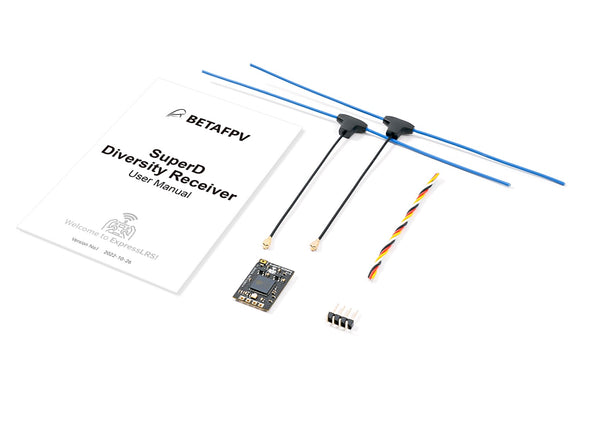
BETAFPV SuperD ELRS is the first True Diversity Receiver that applies two antennas, dual receiver chains, and TCXO (temperature compensated crystal oscillator) tech, achieving a super accurate frequency rate and excellent performance in extreme temperature environments. It offers 2.4GHz and 915MHz/868MHz versions, and greatly fulfills the requirements of reliability for long-range flying, aerial photography, or FPV freestyle tricks.
Check out all our Receivers and the rest of our BetaFPV Products!
A ton of ExpressLRS items are available now!
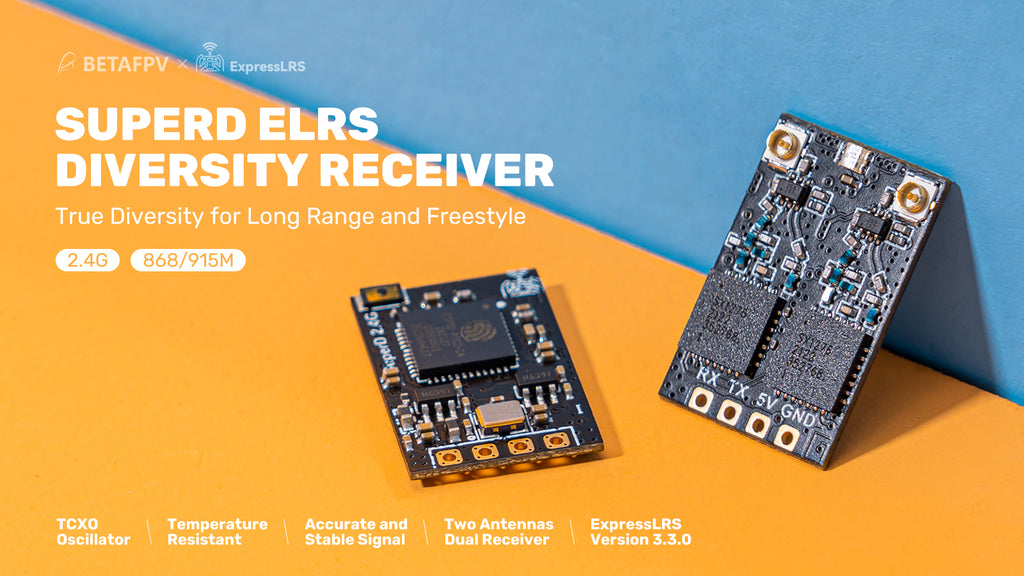
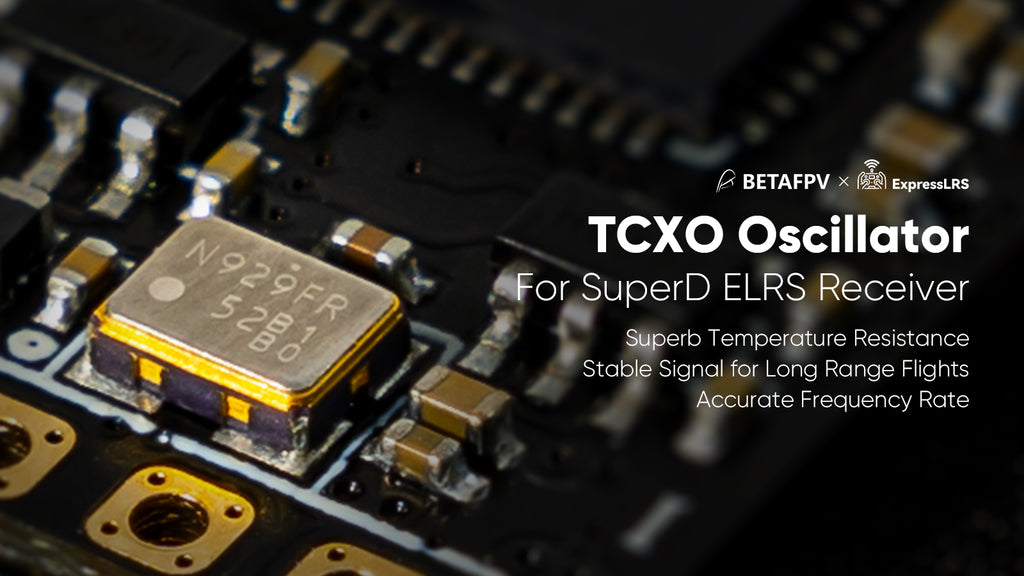
SuperD ELRS 2.4GHz Diversity Receiver is built-in a TCXO (temperature compensated crystal oscillator), which is shared by two RF chips for a super accurate clock source. The true diversity receiver including two RF chips and PA+LNA will generate a large amount of heat when working. With the high-quality TCXO, it can withstand extreme temperatures with no fear of heat and cold, continuously outputting accurate frequency for long-range flight.
SuperD ELRS 2.4GHz Diversity Receiver has dual RF receiver chains with two antennas, ensuring longer and more stable flying for FPV drones and RC airplanes. Choosing a suitable receiver to fly quadcopter or other RC models is very important. BETAFPV ExpressLRS Receivers including ELRS Lite, Nano, Micro, and the newest SuperD, greatly fulfill pilots’ requirements for FPV flying.
| SuperD RX | Micro RX | Nano RX | Lite RX | |
| Weight | 1.1g (2.4GHz), 1.2g (915/868MHz) | 3.5g (RX only) | 0.7g (RX only) | 0.47g (Tower), 0.53g (Flat) |
| Antenna | IPEX MHF1 + T antenna | IPEX MHF1 + T antenna | IPEX MHF1 + T antenna | SMD ceramic antenna |
| MCU | ESP32-PICO-D4 | ESP8285 | ESP8285 | ESP8285 |
| RF Chip | Dual SX128X + Dual PA (2.4GHz), Dual SX1276 (915/868MHz) | SX128X | SX128X + PA, SX1276 + PA | SX128X |
| Frequency | 2.4GHz ISM, 915MHz (FCC), 868MHz (EU) | 2.4GHz ISM | 2.4GHz ISM, 915MHz (FCC), 868MHz (EU) | 2.4GHz ISM |
| Telemetry Power | 100mW | 17mW | 100mW | 17mW |
| Serial Output Protocol | CRSF | PWM or CRSF | CRSF | CRSF |
| Model Type | FPV Drone, Fixed-wing aircraft | Fixed-wing aircraft, Helicopter, RC Cars, RC Boats | FPV Drone | Whoop Drone |
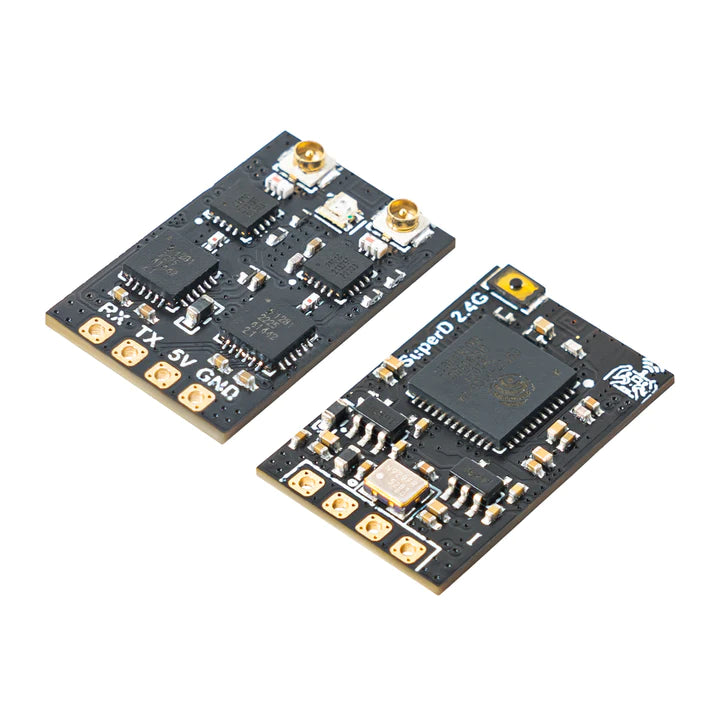
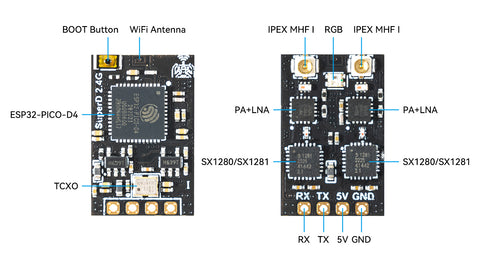
The SuperD receiver 2.4GHz version diagram is shown below.
SuperD receiver RGB status indication is shown below.
| RGB Color | Status | Description |
| Rainbow | Fade effect | Power on |
| Green | Slow flash | WIFI upgrading mode |
| Red | Quick flash | No RF chip detected |
| Orange | Double flash | Binding mode |
| Orange | Triple flash | Connected, but mismatched model-match configuration |
| Orange | Slow flash | Waiting for connection |
| Solid on | Connected and color indicates packet rate |
The RGB light color corresponding to the packet rate is shown in the figure below.
2.4GHz:

Note: F1000 and F500 are packet rates in FLRC mode, providing faster modulation and lower latency, but at the same time having shorter reception distance than normal Lora mode. This mode is great for racers.
D500 and D250 are packet rates in DVDA (Deja Vu Diversity Aid) mode. This mode works at the F1000 data packet rate of FLRC mode, providing better link connection in the case of complex interference by sending the same data packet multiple times. D500 and D250 indicate that the same data packet is sent twice and four times respectively.
915MHz/868MHz:

Note: D50 is a unique mode of ELRS Team900. Under the 200Hz refresh rate of Lora mode, the same data packet is repeatedly sent four times, and the receiving distance is equivalent to 200Hz.
100Hz Full is a mode that realizes 16-channel full-resolution output at the 200Hz refresh rate of Lora mode, and the receiving distance is equivalent to 200Hz.
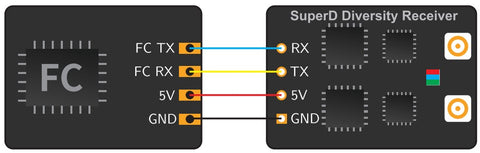
ExpressLRS uses the Crossfire serial protocol (AKA CRSF protocol) to communicate between the SuperD diversity receiver and the flight controller board. Take the flight controller using the Betaflight firmware as an example to introduce its wiring and port configuration.
The connection between the SuperD diversity receiver and the flight controller is shown in the figure below
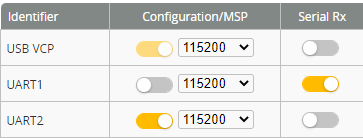
Connect the flight controller to the Betaflight Configurator for basic configuration. First, on the “Port” page, enable the flight controller serial port (take UART1 as an example) as “Serial Rx”.
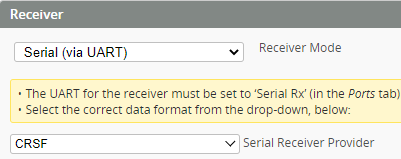
On the configuration page, set Receiver Mode to Serial (via UART) and Serial Receiver Provider to CRSF.
The default firmware of the SuperD diversity receiver uses the ExpressLRS V3.0.0 protocol and has no preset binding phrase. Therefore, the firmware version of the transmitter module must be ExpressLRS V3.0.0 or later versions. Both the receiver and transmitter module should not have any binding phrase.
Note: After binding once, the receiver will remember the autosaved binding phrase and device. Further restarting of the device will be bound automatically without the need for a rebinding process.
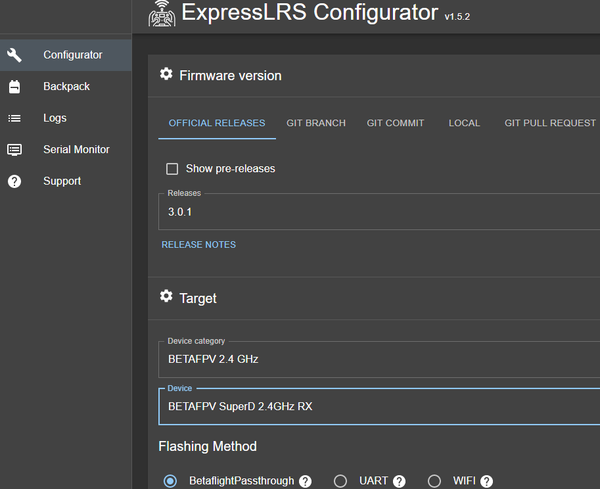
The 2.4GHz default firmware is ELRS V3.0.0. If you would like to bind with a remote control or transmitter module, please upgrade it to V3.0.0 or above. If you would like to flash the latest official ELRS firmware for the SuperD receiver, please upgrade ELRS Configurator to V1.5.2 or above. Select the target device “BETAFPV SuperD 2.4GHz RX”.
ExpressLRS is an open-source RC link for RC applications. Everyone could find this project on Github or join the discussion in Facebook Group.


| Weight | 0.017 kg |
|---|
Only logged in customers who have purchased this product may leave a review.
No account yet?
Create an AccountWXBMW replacement path
Reference item · currently unavailable
BetaFPV SuperD ELRS Diversity Receiver - 2.4GHz remains available as a specification reference. No one-click substitute is verified yet; use the selection, Build and inquiry routes below.
No verified one-click substitute yet. WXBMW will not present an unrelated component as a direct replacement.
Check voltage, dimensions, mounting, protocol, connectors and operating limits. A similar name or size does not prove drop-in compatibility.
Use this listing as a reference inside a system plan; every linked Build still requires component-by-component verification.
Send the reference model and your Build requirements for an available or OEM option review.
Request a WXBMW replacement match









Reviews
There are no reviews yet.