Ready-to-Fly Drones · Shop by specification
Find the right ready-to-fly drones faster.
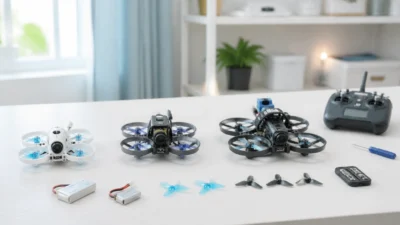
Choose the aircraft type and package format that matches how quickly you want to get flying.

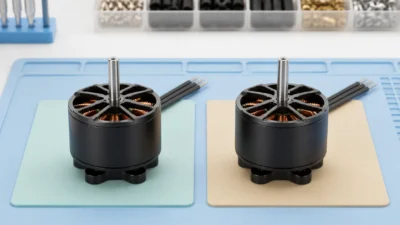
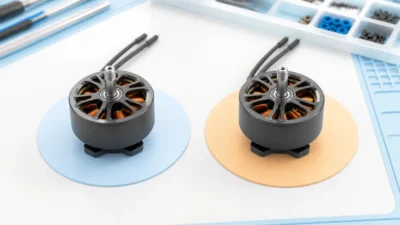
The WXBMW 28xx motor family shares a nominal 28 mm stator width, but 2806.5, 2807, 2810 and 2812 are not interchangeable labels. Stator height, winding KV, motor mass, physical envelope, propeller context and electrical source fields change across the family.
This affiliated comparison uses exact pages from WXBMW supplied DAQI motor catalog (大麒电机-画册.pdf). WXBMW sells every linked product. The page is a specification and build-fit guide, not an independent review or a ranking of thrust, efficiency, speed, endurance, payload or quality.
All five list the same 19*19 4-M3 motor mount and M5 shaft field. That narrows mechanical screening, but it does not prove propeller, voltage, electrical or aircraft compatibility.
| Exact source field | D2806.5-1300KV | D2807-1700KV | D2810-1180KV | D2812-900KV | D2812-1100KV |
|---|---|---|---|---|---|
| Exact stator | Φ28×6.5 | Φ28×7 | Φ28×10 | Φ28×12 | Φ28×12 |
| KV winding | 1300KV | 1700KV | 1180KV | 900KV | 1100KV |
| Catalog weight | 55g | 58g | 70g | 78g | 78g |
| Overall dimensions | Φ32.9×33.1 | Φ33.1×33.5 | Φ33×36 | Φ33×38 | Φ33×38 |
| Battery-cell field | 4s~6s Lipo | 4s~6s Lipo | 4s~6s Lipo | 4s~6s Lipo | 4s~6s Lipo |
| Working-voltage field | 3s~6s / 12V~24V | 3s~6s / 12V~24V | 3s~6s / 12V~24V | 3s~6s / 12V~24V | 3s~6s / 12V~24V |
| Catalog propeller | 7×3.5 | 7x4x3 | 7×4.5×3 | 9x5x3 | 9x5x3 |
| Catalog ESC | 6s / 50A | 6s / 60A | 6s / 60A | 6s / 60A | 6s / 80A |
| Rated current | 13A | 16A | 12A | 18A | 23A |
| Maximum-current field | 45A | 48A | 44A | 46A | 68A |
| Maximum-power field | 1056w | 1053w | 1024w | 1127w | 1122w |
| Motor mounting | 19*19 4-M3 | 19*19 4-M3 | 19*19 4-M3 | 19*19 4-M3 | 19*19 4-M3 |
| Propeller mounting | 5mm | 5mm | 5mm | 5mm | 5mm |
| Shaft thread | M5 | M5 | M5 | M5 | M5 |
| Cable length | 180 | 180 | 180 | 180 | 180 |
| Exact PDF/test context | Page 7; 6 rows; 7×3.5 | Page 10; 6 rows; 7x4x3 | Page 12; 6 rows; 7x4x3 | Page 13; 6 rows; 9x5x3 | Page 14; 6 rows; 9x5x3 |
Maximum current, maximum power, recommended propeller and ESC are literal catalog fields. They are not independently verified universal operating limits. Use them as source inputs for engineering review, not as permission to skip full-system validation.
All five pages list 19*19 4-M3 motor mounting, 5mm propeller mounting, M5 shaft thread and 180 mm cable length. A builder can use these shared fields to reject frames with incompatible hole spacing or shaft hardware.
Shared hole centers do not establish complete fit. Verify motor-base diameter, arm width and thickness, screw engagement, winding clearance, bell clearance, propeller hub thickness, nut direction, cable routing and the actual product revision. Do not use longer screws simply because the stator is taller.
The overall dimensions rise from Φ32.9×33.1 for 2806.5 to Φ33×38 for 2812. That can affect clearance, center of mass, guard geometry and transport even when the bolt pattern matches.
The exact stator heights are 6.5, 7, 10 and 12 mm. Catalog motor weight increases from 55g at 2806.5 to 58g at 2807, 70g at 2810 and 78g at 2812. Four motors therefore change the aircraft mass by roughly four times each individual difference, before propellers, screws and wiring are counted.
A taller stator can change torque capability and thermal mass, but height alone does not prove usable thrust, efficiency or payload. Magnet, winding, air gap, bell, bearing, cooling, propeller, voltage and ESC behavior all contribute. This page does not infer a flight outcome from stator volume.
The lineup spans 900KV to 1700KV. KV describes unloaded speed per volt; it is not a direct rating of power, thrust, aircraft speed or efficiency. A different KV changes winding behavior and the RPM/current relationship under a given load, but the actual operating point depends on voltage sag, propeller load, ESC settings, cooling and aircraft mass.
The two 2812 products make this boundary especially clear. They share documented dimensions, weight, mounting and propeller label, but the 900KV and 1100KV pages list different rated current, maximum-current and ESC fields. Treat them as separate exact power-system options, not a cosmetic suffix choice.
The exact test contexts are D2806.5-1300KV with 7×3.5; D2807-1700KV with 7x4x3; D2810-1180KV with 7x4x3; and both D2812 windings with 9×5×3. Changes in diameter, pitch and blade count alter load, current, RPM, thrust, grams-per-watt and temperature.
D2810 also contains a source-label mismatch: the recommended field says 7×4.5×3, while its test rows say 7x4x3. The draft preserves both rather than silently choosing one.
A valid family comparison would need a documented protocol that selects technically appropriate propellers without overloading a winding, controls voltage and environment, uses the same calibrated equipment, records repeat runs and receives named review. The supplied pages do not prove that protocol.
This exact page documents Φ28×6.5, 1300KV, 55g weight and Φ32.9×33.1 overall dimensions. Mechanical fields are 19*19 4-M3 motor mounting, 5mm propeller mounting, M5 shaft thread and 180 mm cable length.
The source lists 1.3A idle current, 80 internal resistance, 13A rated current, 45A maximum-current field, 1056w maximum-power field and 6s / 50A ESC field. These are catalog labels, not independently verified universal limits.
PDF page 7 contains 6 rows using 7×3.5. Its 7×3.5 recommended-propeller label appears in the exact test rows. The page lists 4s~6s Lipo in the battery field and 3s~6s / 12V~24V in the separate voltage field; this lower-bound conflict remains unresolved. 1 test row(s) exceed the 3% V×A versus reported-watts review threshold. None of these values is transferred to an adjacent stator height or winding.
This exact page documents Φ28×7, 1700KV, 58g weight and Φ33.1×33.5 overall dimensions. Mechanical fields are 19*19 4-M3 motor mounting, 5mm propeller mounting, M5 shaft thread and 180 mm cable length.
The source lists 1.1A idle current, 41 internal resistance, 16A rated current, 48A maximum-current field, 1053w maximum-power field and 6s / 60A ESC field. These are catalog labels, not independently verified universal limits.
PDF page 10 contains 6 rows using 7x4x3. Its 7x4x3 recommended-propeller label appears in the exact test rows. The page lists 4s~6s Lipo in the battery field and 3s~6s / 12V~24V in the separate voltage field; this lower-bound conflict remains unresolved. 4 test row(s) exceed the 3% V×A versus reported-watts review threshold. None of these values is transferred to an adjacent stator height or winding.
This exact page documents Φ28×10, 1180KV, 70g weight and Φ33×36 overall dimensions. Mechanical fields are 19*19 4-M3 motor mounting, 5mm propeller mounting, M5 shaft thread and 180 mm cable length.
The source lists 0.9A idle current, 64 internal resistance, 12A rated current, 44A maximum-current field, 1024w maximum-power field and 6s / 60A ESC field. These are catalog labels, not independently verified universal limits.
PDF page 12 contains 6 rows using 7x4x3. Its recommended-propeller field says 7×4.5×3, while the exact test rows use 7x4x3; the mismatch is retained. The page lists 4s~6s Lipo in the battery field and 3s~6s / 12V~24V in the separate voltage field; this lower-bound conflict remains unresolved. No test row exceeds the 3% arithmetic review threshold. None of these values is transferred to an adjacent stator height or winding.
This exact page documents Φ28×12, 900KV, 78g weight and Φ33×38 overall dimensions. Mechanical fields are 19*19 4-M3 motor mounting, 5mm propeller mounting, M5 shaft thread and 180 mm cable length.
The source lists 0.9A idle current, 82 internal resistance, 18A rated current, 46A maximum-current field, 1127w maximum-power field and 6s / 60A ESC field. These are catalog labels, not independently verified universal limits.
PDF page 13 contains 6 rows using 9x5x3. Its 9x5x3 recommended-propeller label appears in the exact test rows. The page lists 4s~6s Lipo in the battery field and 3s~6s / 12V~24V in the separate voltage field; this lower-bound conflict remains unresolved. No test row exceeds the 3% arithmetic review threshold. None of these values is transferred to an adjacent stator height or winding.
This exact page documents Φ28×12, 1100KV, 78g weight and Φ33×38 overall dimensions. Mechanical fields are 19*19 4-M3 motor mounting, 5mm propeller mounting, M5 shaft thread and 180 mm cable length.
The source lists 0.9A idle current, 82 internal resistance, 23A rated current, 68A maximum-current field, 1122w maximum-power field and 6s / 80A ESC field. These are catalog labels, not independently verified universal limits.
PDF page 14 contains 6 rows using 9x5x3. Its 9x5x3 recommended-propeller label appears in the exact test rows. The page lists 4s~6s Lipo in the battery field and 3s~6s / 12V~24V in the separate voltage field; this lower-bound conflict remains unresolved. 1 test row(s) exceed the 3% V×A versus reported-watts review threshold. None of these values is transferred to an adjacent stator height or winding.
Across these five pages, 5 battery/working-voltage conflicts, 1 recommended-versus-tested propeller mismatch and 6 V×A/reported-watts review rows remain open. None is silently corrected or used for a comparative performance conclusion.
Verify whether the intended 7-inch-class propeller label, voltage and frame role are supported by exact evidence. The 6.5 and 7 mm stators are close in height, but their 1300KV and 1700KV windings, propeller fields, resistance and current rows differ. Do not treat them as adjacent interchangeable options.
Resolve the 7×4.5×3 versus 7×4×3 source-label mismatch first. Then verify the 70 g motor mass, 36 mm overall length, exact voltage and current path. Do not use a neighboring 2807 or 2812 test table to fill the gap.
Choose between 900KV and 1100KV only after fixing propeller, voltage, ESC, aircraft mass and thermal target. The exact pages share mechanical fields and a 9×5×3 context, but winding-specific current and source-data quality still require review.
Browse all WXBMW motors and read the motor stator, KV, voltage and propeller guide. Match the propeller, ESC, battery and frame before ordering.
Use the 5-inch Freestyle build path and Long Range build path as planning routes only; neither route proves automatic compatibility. For an unavailable-motor replacement or OEM build, send WXBMW the exact stator, KV, propeller, voltage, ESC, mount, shaft, frame, all-up weight and payload requirements.
No. Stator height is one design input. Usable thrust depends on the exact winding, propeller, voltage, ESC, cooling and aircraft, and the supplied pages are not one normalized family test.
They share listed mounting and shaft fields, but complete dimensions, weight, propeller context and electrical behavior differ. Verify the real motor base, arm, screws, hub and cable route.
No. Their exact KV, propeller fields and test contexts differ. D2810 also has a recommended-versus-tested propeller-label mismatch.
The exact source pages share the 9×5×3 label and closely aligned voltage rows, so a dedicated exact-pair page can show source observations with explicit limits. That still is not a universal performance ranking.
No final conclusion is made here. Every page lists 4S–6S in one field and 3S–6S / 12–24V in another. Confirm the exact revision before use.
No account yet?
Create an Account