

Ready-to-Fly Drones · Shop by specification
Find the right ready-to-fly drones faster.
Choose the aircraft type and package format that matches how quickly you want to get flying.

Choose an FPV motor by matching the complete aircraft, not by comparing KV alone. Frame and propeller size define the mechanical envelope; stator dimensions influence torque and thermal capacity; KV must suit battery voltage and propeller load; mounting, shaft and wire details must physically fit. The final decision should be checked against test data for the exact motor, voltage and propeller combination.
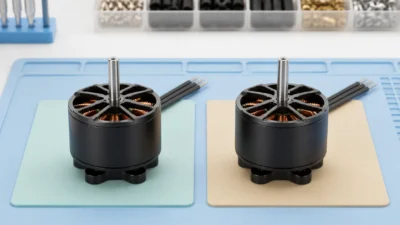
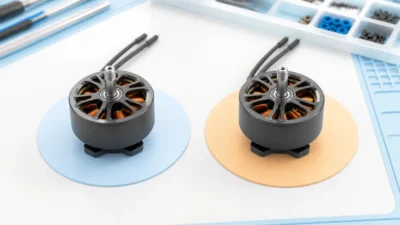
A designation such as 2207 usually describes a stator approximately 22 mm in diameter and 7 mm tall. It is not the outside diameter or total motor height. A larger stator can generally produce more torque and dissipate more heat, but winding, magnet strength, air gap, bearing quality, bell design and cooling also matter. Two motors with the same stator code are not automatically equivalent.
| Build class | Common starting direction | Selection checks |
|---|---|---|
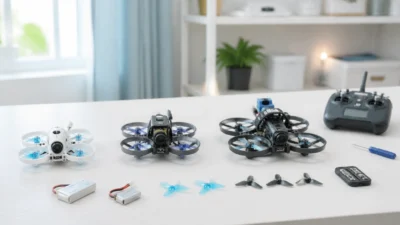
| Tinywhoop / ultralight | Small stator and high KV appropriate to 1S–2S | Duct clearance, press-fit or T-mount prop, connector and all-up weight |
| Micro 2–4 inch | Motor sized around the exact propeller and payload | Mount pattern, shaft format, voltage and thermal headroom |
| Cinewhoop | Torque-focused motor for ducted propeller and camera payload | Duct airflow, total weight, sustained current, heat and noise |
| 5-inch freestyle | Commonly a 22xx-class motor, selected around 4S or 6S | KV, propeller test rows, peak current, frame arm clearance and durability |
| Long range / large prop | Lower-KV, torque- and efficiency-focused system | Cruise efficiency, battery reserve, vibration and sustained temperature |
These are starting directions, not universal fitment rules. A lightweight build and a heavy payload build using the same propeller diameter can require different motors.
KV describes unloaded speed per volt in idealized terms. It is not a wattage or quality rating. A higher-KV motor tends toward higher speed at the same voltage, while a lower-KV motor is commonly paired with higher voltage or a larger propeller. Real loaded speed is lower and depends on winding resistance, battery sag, ESC behavior and propeller torque.
Do not copy a KV value from a different stator size or propeller. For example, a 6S 5-inch setup normally uses a lower KV than a comparable 4S setup, but the safe choice still depends on the exact motor and propeller test data.
Battery voltage and propeller load determine how hard the motor and ESC work. Increasing voltage, diameter, pitch or blade count can increase current and temperature. A propeller that fits the frame can still overload the motor. Use the exact test row closest to the intended battery voltage and propeller, then keep practical margin for battery condition, air density, cooling and manufacturing variation.
| Test-table field | How to use it | Do not assume |
|---|---|---|
| Voltage / cell count | Match the intended charged pack and operating range | A 4S result predicts 6S behavior |
| Propeller model | Match diameter, pitch, blade count and preferably exact model | All props with the same diameter load identically |
| Current | Size ESC, battery and wiring with margin | Bench peak equals every in-flight condition |
| Thrust | Compare with all-up weight and desired thrust-to-weight ratio | Four times one motor’s static thrust equals guaranteed flight performance |
| Efficiency | Compare at relevant throttle points, especially for endurance | Maximum-throttle efficiency represents cruise |
| Temperature / test duration | Use when published to judge thermal confidence | A short test proves unlimited sustained operation |
Freestyle selection balances response, durability and usable efficiency. Racing prioritizes rapid acceleration and a low rotating mass within current limits. Cinewhoop motors must handle ducted loading and payload without excessive heat. Long-range systems prioritize efficient cruise and reserve rather than maximum static thrust. Heavy-lift systems require verified thrust data, redundancy planning and much larger thermal and electrical margins.
Browse WXBMW FPV motors, then verify the matching propeller, ESC and battery. For a complete platform, use the 5-inch Freestyle, Cinewhoop or Long Range build path. If replacing a discontinued motor, send WXBMW the stator size, KV, voltage, propeller, mounting pattern, shaft and current requirement for an OEM match.
No. KV is a speed constant, not a direct power rating. Motor size, voltage, current capability, propeller and thermal design determine useful output.
Only when the exact motor and propeller combination is explicitly supported at 6S. Reducing propeller load or throttle limit is not a substitute for verified manufacturer data.
It is safer to match model and KV across the set. A different motor can change thrust response, filtering, temperature and handling even if the mounting holes fit.
Start from trustworthy motor test current at the intended voltage and propeller, then add operating margin. Consider burst duration, cooling, battery capability and the ESC manufacturer’s rating conditions.
Next step after this guide
Use the guide to define the required specifications, verify the aircraft-level Build path, then compare current WXBMW parts. Recheck voltage, mounting, protocol, connector and load compatibility before ordering.
No in-stock WXBMW option is shown for this exact category right now. Use the specification-match request instead of assuming a nearby item is compatible.
You must be logged in to post a comment.
No account yet?
Create an Account





3 thoughts on “How to Choose FPV Motors: Stator Size, KV, Voltage and Propeller Match”